Tray Bien: Twenty-Five Airport Hooks for a Calmer Run to the Gate
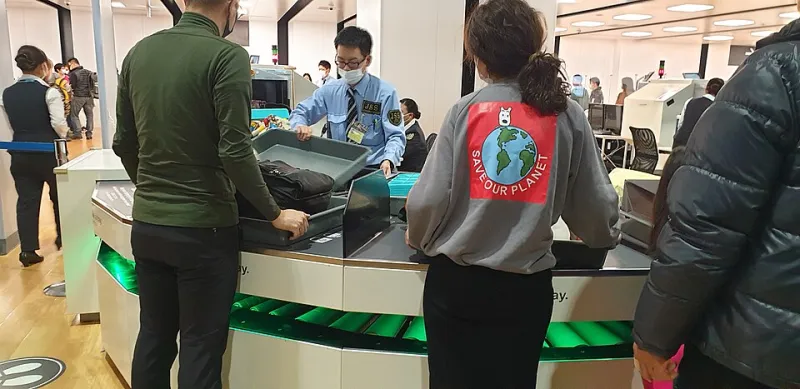
Photo: Jeena Paradies from Varberg, Schweden, CC BY 2.0, via Wikimedia Commons
Airports are where a holiday either starts with a smug little swagger or a sweaty fumble at the tray table. The good news is that the Spanish, French and Italian you need between the drop-off kerb and the departure gate is a small, repetitive vocabulary — roughly twenty-five words doing all the work. Learn them as pictures rather than lists, and the whole run starts to feel like a route you already know.
Security: trays, liquids and the dreaded belt
Liquids — líquidos, liquides, liquidi. Picture a security guard standing in a lido-sized puddle, tutting. One image covers all three spellings.
Tray — bandeja (ES), bac (FR), vassoio (IT). The Spanish bandeja is a bandit's tray: a masked robber calmly emptying his pockets into it. The French bac is a baccy tin — small, grey, holds your keys and nothing else. The Italian vassoio sounds like a vase on a tray, which is exactly what you must not try to carry through.
Clear bag — bolsa transparente / sac transparent / sacchetto trasparente. Transparent is a genuine freebie across all three, so the only word to nail is bag: bolsa, sac, sacchetto.
Belt — cinturón / ceinture / cintura. Imagine a cinema usher's torch beam — "sin-torch-on" — sweeping your waist as you shuffle forward in socks.
Hand luggage — equipaje de mano / bagage à main / bagaglio a mano. Mano and main both mean hand; picture a tiny suitcase growing out of your palm.
Security — seguridad / sécurité / sicurezza. All three sit close to the English "secure", so file this one as a gift and spend your memory on the tray instead.
Queue — cola / file / fila. Spanish cola also means tail, so picture the queue as one long animal tail. French file is a file of soldiers. Italian fila is a row of dominoes waiting to topple.
Passport control: the quiet bit
Passport control — control de pasaportes / contrôle des passeports / controllo passaporti. Almost identical, so use the hook for the sign rather than the meaning: three passport-sized kiosks wearing monocles.
Boarding pass — tarjeta de embarque / carte d'embarquement / carta d'imbarco. Embarque, embarquement and imbarco all come from the same "em-bark" root. Picture a little boat at the gate, waiting to ferry you to the plane.
This way — por aquí / par ici / di qua. Learn these as one sound: "here-ish". Add a vague wave to the right and everyone understands.
Shoes off — quítese los zapatos / retirez vos chaussures / si tolga le scarpe. You will mostly hear this as a gesture and a sigh, but zapatos, chaussures and scarpe are worth banking for the return leg.
The gate: delays, aisles and announcements
Gate — puerta / porte / porta. A door by any other name. Puerta de embarque, porte d'embarquement, porta d'imbarco — the second word is the one to listen for.
Delay — retraso / retard / ritardo. Retard is a false friend in most English contexts, but here it simply means late. Picture a tortoise in a high-vis vest holding up an entire plane.
Cancelled — cancelado / annulé / cancellato. The French is the odd one out; picture a big red rubber stamp marked annulé coming down on your boarding pass.
Final call — última llamada / dernier appel / ultimo avviso. Llamada and appel both mean a call; avviso is a notice. Picture a tannoy shaped like a llama — llamada — bleating your name across the terminal.
Boarding — embarque / embarquement / imbarco. Same boat as the boarding pass. If you have that one, you have this one.
Seat, row, aisle, window — asiento, fila, pasillo, ventanilla; siège, rang, couloir, hublot; posto, fila, corridoio, finestrino. Prioritise aisle: pasillo and corridoio sound like long corridors, while French couloir is almost "cool corridor". Window is a little window, a porthole, a small opening — ventanilla, hublot, finestrino.
Baggage reclaim and the exit
Baggage reclaim — recogida de equipajes / livraison des bagages / ritiro bagagli. Recogida and ritiro both mean a collection; livraison is a delivery. Picture a baggage handler passing your case over the counter like a pizza.
Carousel — cinta / tapis / nastro. A belt, a carpet, a ribbon. All three describe the same slow-moving loop of hope.
Lost — perdido / perdu / smarrito. Perdido and perdu sit close to "perished"; smarrito sounds like "smeared". Either way, it is the word you want on the form.
Exit — salida / sortie / uscita. Salida is a saloon door swinging outward; sortie is a sortie; uscita is the "out" you are after.
Taxi rank — parada de taxis / station de taxis / posteggio taxi. Parada and posteggio are stops; station is, well, a station. Point at the queue and you are sorted.
A note on queue culture
Spanish queues can be cheerfully ambiguous — ask ¿es aquí? ("is this the queue?") and you will usually be waved into place. French queues are more formal and quietly policed; a murmured pardon gets you further than a shrug. Italian queues often dissolve into a loose crowd at the gate itself, so keep an eye on the door rather than the line. None of this is a rule, just weather.
The one to remember
If you learn nothing else, learn the tray word. It is the first thing you will hear and the first thing you will need. The moment you say bandeja, bac or vassoio with a smile, the airport switches from obstacle course to a place you can navigate — and the holiday starts a good twenty minutes earlier.