Barrier Bravery: Twenty Word Links for a Calm Run Through French, Italian and Spanish Tolls
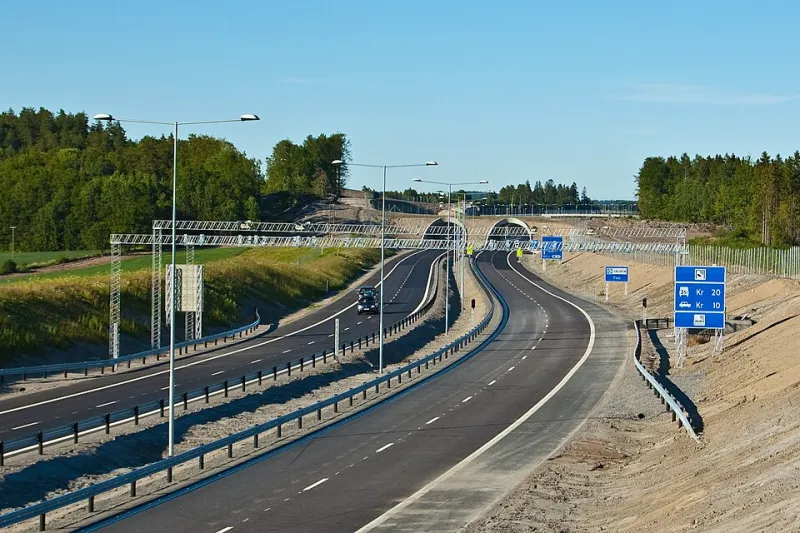
Photo: Peter Fiskerstrand, Public domain, via Wikimedia Commons
There is a particular kind of silence in a hire car as a toll barrier appears ahead. The queue is moving, the signs are foreign, and your passenger is suddenly very interested in the glovebox. The good news is that motorway tolls in France, Italy and Spain are broadly similar: take a ticket, pay at the other end, keep the receipt, don't hit the barrier. The vocabulary is the only wobbly bit, and that is exactly where a few linkwords earn their keep.
Start with the three toll words
1. Péage (French) — say it like pay-ahj and think of the age of paying. You have reached the age where the motorway asks for its money. Péage is the whole toll plaza, not just the booth.
2. Pedaggio (Italian) — sounds like pedal plus Joe. Picture Joe pedalling a bicycle up to the booth with his wallet out. Pedal, Joe, pedaggio.
3. Peaje (Spanish) — say pay-HAY. At the barrier you think pay, hey, and hope the car behind is not joining in.
Signs on the approach
4. Barrière, barriera, barrera — the barrier. It is almost English already; just add an accent or an extra syllable and picture a British barrier shrugging in a continental way.
5. Voie, corsia, carril — lane. Voie sounds like vwah, as if a voice is telling you which lane to choose. Corsia sounds like course-ee-ah: pick your course. Carril sounds like car-reel: reel your car into line.
6. Télépéage, Telepass, Telepeaje — the electronic tag lane. Télépéage is tele-pay-age; Telepass is a pass; Telepeaje is tele-pay-hey. If you do not have a tag, do not drift into the lane with the orange t or Telepass sign unless you enjoy reverse gear and apologetic hand gestures.
7. Hauteur, altezza, altura — height. All three sit close to altitude. If you have a roof box, a tall van or a suspiciously ambitious luggage stack, use the lane with a person in it rather than the low automated barrier.
8. Entrée, entrata, entrada — entry. Entrée is entrance with a French accent. Entrata and entrada share the entr- start. This is where you take the ticket on a closed system.
At the machine
9. Ticket, biglietto, billete — ticket. Biglietto sounds like bill-yetto, a little bill you get at the start. Billete sounds like bill-et. Keep it safe; it is your proof of where you joined the motorway.
10. Carte bancaire, carta di credito, tarjeta — bank card. Carte is card with an e; carta is card with an a; tarjeta sounds like tar-jay-ta, so target the card slot.
11. Espèces, contanti, efectivo — cash. Espèces sounds like ess-pess, as in spare cash at the bottom of your bag. Contanti sounds like con-tan-tee: count the notes. Efectivo sounds like effect-ee-vo: cash makes the barrier move.
12. Monnaie, resto, cambio — change. Monnaie sounds like money. Resto is what is left over. Cambio is change, as in a change of coins.
13. Reçu, ricevuta, recibo — receipt. Reçu sounds like ruh-soo: receipt, so? Ricevuta sounds like ree-che-voo-ta: reach for the receipt. Recibo sounds like re-see-bo: the receipt you see before you bin it.
14. Appuyez, premere, pulse — press. Appuyez sounds like a-pwee-yay, a little push. Premere sounds like prem-air-ay: press the button. Pulse is a straight command to press.
15. Paiement, pagamento, pago — payment. Paiement looks like payment with extra vowels. Pagamento is payment in a smarter suit. Pago is pay-go: pay and go.
If the barrier sulks
16. Perdu, smarrito, perdido — lost. Perdu sounds like per-DOO: the ticket has done a runner. Smarrito sounds like sma-ree-toe: the smart ticket has gone missing. Perdido sounds like per-dee-do: lost, but with a shrug.
17. Assistance, assistenza, asistencia — help. All three begin with assist. Press the intercom button, say the word, and hold up the ticket or rental paperwork.
18. Sans arrêt, senza sosta, sin parar — without stopping. Sans arrêt sounds like sanz-a-RAY: no arrest, just roll through. Senza sosta means without a stop. Sin parar means no pause. These are for tag lanes only, not for hopeful tourists in a Fiat.
19. Sortie, uscita, salida — exit. Sortie sounds like sort-ee: sort out your exit. Uscita sounds like you-she-ta: you shoot out. Salida sounds like sa-lee-da; think of exiting before the salad gets warm.
20. Borne, cassa, cabina — machine or booth. Borne sounds like born: born to pay. Cassa sounds like cash: the cash desk. Cabina is the little cabin where a human can rescue you.
The calm barrier routine
Before you set off, check whether your route has tolls and whether the hire car already has a tag. If it does, read the rental terms before you sail into a Telepass or Via-T lane. Keep a bank card and a small amount of cash within reach, not buried under the spare wheel. A UK debit card usually works, but tell your bank you are abroad if it is prone to dramatic pauses.
On the approach, read the overhead symbols early. A green arrow means open. Coins and notes mean cash. A card symbol means card. An orange t, Telepass or Télépéage sign means tag holders only. Choose a lane while you still have room to change your mind, not while the barrier is rising in front of you.
If a machine gives you a ticket, take it and put it somewhere obvious. At the payment end, insert the ticket, read the amount, then pay by card or cash as shown. Take the receipt even if you usually refuse one; it is useful if a hire company later asks about toll charges. Wait for the barrier to lift fully before moving. Do not tailgate the car in front, even if the queue behind you is making its feelings known.
If you lose the ticket, do not reverse down the motorway. Press the intercom and use the linkword: ticket perdu, biglietto smarrito or billete perdido. Have your rental agreement ready. You may be charged a missing-ticket fee, but a calm explanation beats a dramatic re-enactment of a heist film.
Finally, pull away steadily and let the barrier close behind you. You have just paid a toll in three languages without leaving the driver's seat. That is a small travel win worth remembering, preferably before the next péage appears.