The Mirror Test: 20 Linkword Hooks for Clothes Shopping in Spain, France and Italy
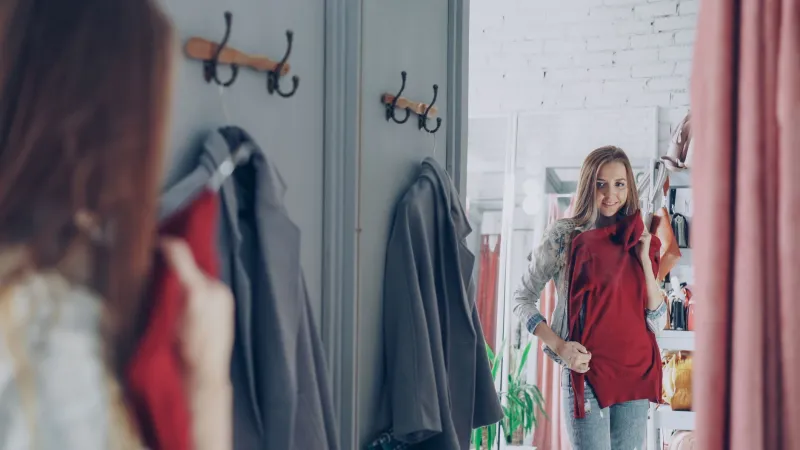
Clothes shopping abroad is rarely the reason you booked the flight. But a forgotten jumper, a sudden cold snap or a very good window display can pull you into a shop — and straight into a game of bilingual charades. The Linkword method is simple: attach the foreign word to an English sound-alike, picture the silly scene, and let the image do the remembering. These 20 hooks cover the size labels, colour words and fitting-room phrases that matter when you are standing in front of a mirror in Spain, France or Italy.
The label is not the whole story
Before the hooks, a reality check. UK clothing sizes do not travel neatly. A UK 10 is often around a European 38, while Italian sizes frequently run a couple of points higher, but cut and brand matter far more than any conversion chart. Shoes are separate again: Spanish and Italian shops usually ask for your número, while French shops want your pointure. The word for clothing size is talla in Spanish, taille in French and taglia in Italian. Learn those three and you have unlocked the first door.
- Spanish talla — say it like 'TALL-ah'. Picture yourself standing taller in the mirror because the size is right. '¿Tiene una talla más?' means 'Do you have a size up?'
- French taille — pronounced 'tie'. Imagine tying the size tag to your wrist so you do not forget it. In France, ask 'Vous avez une taille au-dessus ?' for the next size up.
- Italian taglia — 'TAG-lee-ah'. A price tag with the size on it is your mental picture. 'Ha una taglia in più?' is the same question in Italian.
Four ways to ask for a different fit
The next hurdle is explaining that the thing you are holding is not quite right. You do not need a full fashion vocabulary; you need a handful of comparison words and the confidence to use them.
- más, plus, più — all mean 'more'. Spanish más sounds like 'mass', so imagine needing more mass in the fabric. French plus sounds like 'ploo', and Italian più like 'pew' — as in an extra seat on the train. Try '¿Tiene una talla más?', 'Vous avez une taille en plus ?' or 'Ha una taglia in più?'
- grande, grand, grande — big. The grand hotel is big; the same idea works in all three languages. Ask '¿Lo tiene en talla grande?', 'Vous l'avez en plus grand ?' or 'Ce l'ha più grande?'
- pequeño, petit, piccolo — small. Picture a petit four, the tiny cake, or a piccolo flute. Ask '¿Lo tiene en pequeño?', 'Vous l'avez en plus petit ?' or 'Ce l'ha più piccolo?'
- mediano, moyen, medio — medium. Think 'middle'. In a Spanish shop, mediano sits in the middle of the rail; in French, moyen is the middle option; in Italian, medio is the middle size.
Eight colour words that earn their keep
Colours are where false friends and near-misses can make a simple request go sideways. These eight are the ones most likely to appear on a label, a hanger or a helpful assistant's lips.
- rojo, rouge, rosso — red. Spanish rojo sounds like 'ro-ho'; picture a red Santa hat. French rouge is the colour of blusher. Italian rosso is the colour of a big glass of red wine.
- azul, bleu, blu — blue. Spanish azul sounds like 'a pool' — a blue pool. French bleu is almost the English word with a French accent. Italian blu is 'blue' with the final e chopped off.
- verde, vert, verde — green. All three come from the same Latin root, and 'verdant' gives you the English bridge. Picture a green garden.
- negro, noir, nero — black. French noir is the dark of film noir; Spanish negro sounds like 'night-gro'; Italian nero makes you think of a strong black coffee.
- blanco, blanc, bianco — white. Spanish blanco is a blank white page; French blanc is the same blank page; Italian bianco sounds like a white bee in a white shirt.
- amarillo, jaune, giallo — yellow. Spanish amarillo sounds like 'a-marrow' — picture yellow marrow in a bone. French jaune is the yellow of jaundice. Italian giallo is the yellow of old crime paperbacks.
- gris, gris, grigio — grey. Spanish and French gris sound like 'grease' — a grey grease stain. Italian grigio sounds like 'gree-joe', a grey Joe.
- marrón, marron, marrone — brown. Picture a brown chestnut — marron in French is exactly that. Spanish marrón and Italian marrone are close cousins.
Five fitting-room lifelines
The fitting room is the final boss. In smaller shops you may need to ask; in bigger chains you may need to queue. Either way, a few phrases will stop you from miming 'can I take my coat off in here?' to a confused assistant.
- probador, cabine d'essayage, camerino — fitting room. Spanish probador sounds like 'probe door' — the door where you probe the fit. French cabine is a little cabin. Italian camerino is a small camera room, complete with mirror.
- probármelo, l'essayer, provarlo — to try it on. Spanish probar means to try or test; French essayer sounds like 'essay' — imagine writing an essay about the fit; Italian provare is to prove or test. Say '¿Puedo probármelo?', 'Je peux l'essayer ?' or 'Posso provarlo?'
- ¿Me queda bien?, Ça me va ?, Mi sta bene? — does it suit me? Spanish quedar means to fit or remain; French aller is to go; Italian stare is to stay. Picture the garment asking, 'Do I stay or go?'
- me lo llevo, je le prends, lo prendo — I will take it. Spanish llevar is to carry; French prendre is to take; Italian prendere is to take. Picture carrying it to the till.
- devolución, retour, reso — return. Spanish devolver is to give back; French retour is a return ticket; Italian reso is a return. Say '¿Puedo devolverlo?', 'Je peux le retourner ?' or 'Posso renderlo?'
The etiquette bit
A few cultural notes will make you feel less like a tourist and more like a local. In France, always open with 'Bonjour' before asking for help; it is not optional. In Spain and Italy, a friendly 'Hola' or 'Buongiorno' goes a long way in smaller shops. If you are only browsing, say 'Sólo estoy mirando', 'Je regarde seulement' or 'Sto solo guardando'. And if you take three sizes into the fitting room, try to keep it to three — the assistant is not running a personal warehouse.
The Linkword approach works best when you make the image vivid and a little ridiculous. A taller version of yourself, a tie around a size tag, a white bee in a shirt: these are the things that stick. Learn five before you go and you will spend less time pointing at the rail and more time enjoying the city.