Curb Appeal: 20 Memory Hooks for Taxi Rides in Spain, France and Italy
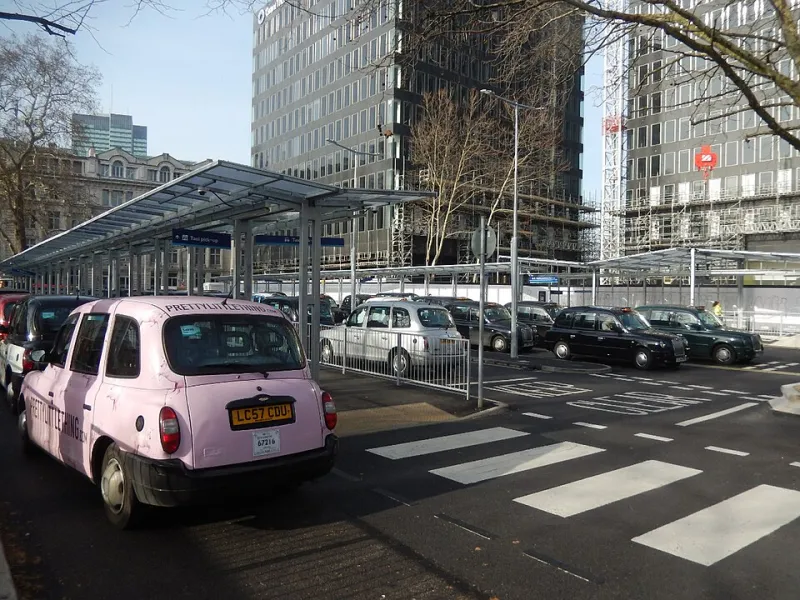
Photo: Stephen McKay , CC BY-SA 2.0, via Wikimedia Commons
A taxi should be the easy bit of a city break. You have walked the miles, eaten the pastry, bought the fridge magnet, and now you just want a door-to-door finish. Then the driver asks something you do not quite catch, the meter is doing something mysterious, and your card is suddenly the subject of a international negotiation.
At Linkword Languages, we like a shortcut that survives real life. So here are 20 sound-alike memory hooks for Spanish, French and Italian cab rides — not to turn you into a linguist, but to get you from the restaurant to the hotel without pointing at your phone like a lost tourist.
First, find the rank
1. Spanish: parada de taxis — say it like 'parade of taxis'. Picture the official rank as a little parade of cars waiting for you. It also stops you wandering into the road and waving at passing traffic.
2. French: station de taxis — happily, 'station' is very close to the English word. Think of the taxi station as the place where cabs line up, not where trains go.
3. Italian: fermata del taxi — 'fermata' sounds a bit like 'firm stop'. A firm stop is exactly what a taxi rank is: a proper place to stand.
4. The freebie: taxi — in all three languages, taxi is taxi. Use it confidently. You have already learned one word before the door opens.
Getting in and saying where
5. Spanish: ¿Puede llevarme a...? — 'pway-day yeh-var-may ah'. Think 'can you carry me to...'. It is the polite way to give an address. Add the place name and you are away.
6. French: Vous pouvez m'emmener à...? — 'm'emmener' sounds like 'Emma takes you'. Imagine Emma from accounts driving you to the hotel. Strange, but memorable.
7. Italian: Può portarmi a...? — 'portarmi' sounds like 'port arms'. Picture the driver carrying your bags like a soldier on duty. It means 'can you take me to...'.
8. Address words: Spanish dirección, French adresse, Italian indirizzo. The first two are nearly English. For Italian, think 'indicate the address' — 'indirizzo' starts with the same 'indi' sound.
The meter and the money
9. Spanish: taxímetro — almost identical to 'taxi meter'. If you can say taxi, you can say this.
10. French: compteur — sounds like 'count-ur'. The meter counts. That is the whole trick.
11. Italian: tassametro — 'taxi' plus 'metro' squashed together. It is the meter, not the underground.
12. Spanish: ¿Cuánto cuesta? / French: Combien ça coûte? / Italian: Quanto costa? — all three are cousins of 'quantity' and 'cost'. You are asking 'how much does it cost?' without any grammar gymnastics.
13. Card words: Spanish tarjeta, French carte bancaire, Italian carta. 'Tarjeta' and 'carta' look like 'card'. In French, say 'carte bancaire' to be clear you mean a bank card, not a menu card.
14. Cash words: Spanish efectivo, French espèces, Italian contanti. For French, think 'cash is a species' — 'espèces' sounds like 'species'. For Italian, 'contanti' sounds like 'count-anty': you are counting out notes.
Stop, wait, boot
15. Stop here: Spanish Pare aquí ('par-ay ah-key'), French Arrêtez-vous ici ('ar-ray-tay voo ee-see'), Italian Si fermi qui ('see fair-mee kwee'). Think 'par' for Spanish, 'arrest' for French, and the scientist Fermi for Italian. All three mean stop.
16. Wait: Spanish Espere, French Attendez, Italian Aspetti. French 'attendez' sounds like 'attend' — attend to the waiting. Italian 'aspetti' sounds like 'aspect': wait a moment and consider the aspect.
17. The boot: Spanish maletero, French coffre, Italian bagagliaio. 'Maletero' sounds like 'mallet' — imagine needing a mallet to shut an overpacked boot. French 'coffre' sounds like 'coffin' — a dark, boxy place for luggage. Italian 'bagagliaio' is baggage with an Italian flourish.
18. Airport and station: Spanish aeropuerto / estación, French aéroport / gare, Italian aeroporto / stazione. Most are obvious. French 'gare' is the odd one out — remember 'gare' as the station where you must be on guard for your train.
Paying and getting the receipt
19. Receipt: Spanish recibo ('re-see-bow'), French reçu ('ruh-soo'), Italian ricevuta ('ree-che-voo-ta'). Think of the Spanish one as a little bow of paper. French 'reçu' is short and sharp. Italian 'ricevuta' sounds like 'received-a' — you have received it.
20. Keep the change: Spanish Quede con el cambio, French Gardez la monnaie, Italian Tenga il resto. This is a bonus hook for when you are feeling generous. 'Cambio' and 'monnaie' both relate to change; 'resto' in Italian sounds like the rest of the money.
Three mini-dialogues to rehearse
Spain
You: '¿Puede llevarme a la estación?' Driver: 'Sí, claro.' You: '¿Cuánto cuesta, más o menos?' Driver: 'Unos doce euros.' You: '¿Puedo pagar con tarjeta?' Driver: 'Sí.'
France
You: 'Bonjour, vous pouvez m'emmener à mon hôtel?' Driver: 'Bien sûr.' You: 'Le compteur est allumé?' Driver: 'Oui.' You: 'Arrêtez-vous ici, s'il vous plaît.'
Italy
You: 'Buonasera, può portarmi in centro?' Driver: 'Certo.' You: 'Quanto costa?' Driver: 'Circa quindici euro.' You: 'Si fermi qui. Pago con carta.'
UK-friendly taxi checks
In the UK we are used to black cabs, minicabs and apps, but abroad it pays to check the basics before you set off. Use the official rank where you can, especially at night or at a station. If you are unsure about the meter, ask '¿Está el taxímetro encendido?' in Spanish, 'Le compteur est allumé?' in French, or 'Il tassametro è acceso?' in Italian. It is a mouthful, but the memory hook is simple: meter on means you are paying for the ride, not for a chat.
Card acceptance varies. A quick 'tarjeta?', 'carte bancaire?' or 'carta?' before you get in saves a awkward stop at a cash machine. And if you need a receipt for expenses, ask for 'recibo', 'reçu' or 'ricevuta' as you pay, not after the driver has already pulled away.
One last thing: the meter is not a suggestion. If the fare seems wildly off, ask for the receipt and note the licence number. But most rides are straightforward once you have the words. Learn the hooks, keep the phrasebook in your pocket, and let the last journey of the trip be the calm one.