Fringe Benefits: 20 Memory Hooks for Braving a Barber Abroad
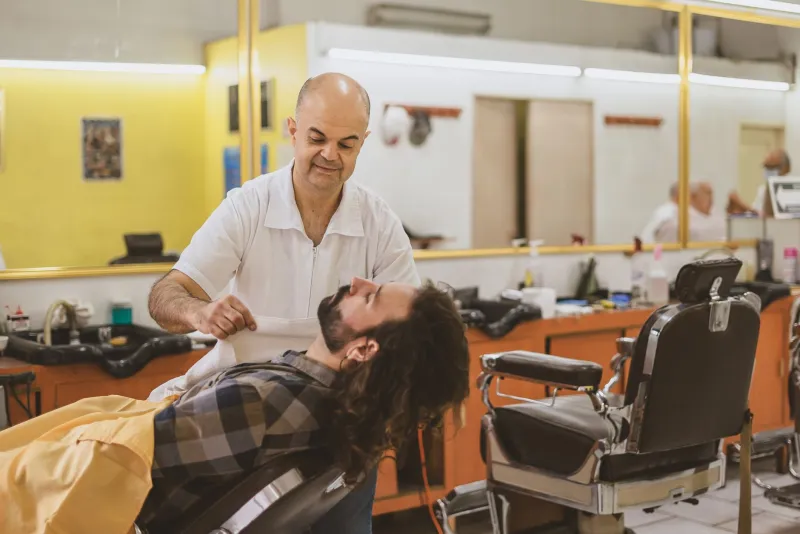
You can order a cortado, ask where the loos are and apologise for your Spanish in the same breath. Then the chair reclines, the clippers buzz, and your entire vocabulary shrinks to a nervous smile and the word yes. A haircut is the one holiday errand where a misunderstanding does not just cost you twelve euros — it costs you three weeks in a hat.
The good news is that the phrases you need are few, short, and strangely easy to pin to something silly. Here are twenty links to load up before you sit down in Spain, France or Italy. Say each one out loud once, picture the daft image, and it will still be there when the gown goes on.
First, the two words that save everything
Everything starts with a little. If you can say a little, you can steer.
- Un poco (Spanish) — think a poor coat. You want a poor coat's worth off the top. Not a coat. A poor coat.
- Un peu (French) — think a puff. One puff of hair, nothing more. The sound is barely a sigh, which is exactly the mood you want in the chair.
- Un po' (Italian) — think of a po' boy sandwich: small, unfussy, exactly enough. Say it with a pinch of your fingers and you are already halfway there.
Then add the word for shorter.
- Más corto (Spanish) — a mass of hair, but court-short. Tennis-court short, not football-pitch short.
- Plus court (French) — a plume, cut short. Ploo coor. Two syllables, no drama, no negotiation.
- Più corto (Italian) — picture a tiny tennis court with a net you could step over. Pyoo cor-toh.
Where, exactly? The back, the sides, the rest
Pointing helps, but pointing plus a word feels like competence rather than panic.
- Por detrás (Spanish) — the poor thing behind you. Poor deh-TRASS. That is the back of your head.
- Derrière (French) — the rear. Genuinely almost English with a French accent bolted on. Free word, take it.
- Dietro (Italian) — dee-yet-tro. Whisper it like you are telling someone there is something behind them in a theatre.
'Not too much' — the politest fight you will ever have
This is the sentence people forget, and it is the one that matters most. Barbers abroad are not villains; they are enthusiastic.
- No demasiado (Spanish) — no, Demi's yahoo. Politely decline the drama.
- Pas trop (French) — pa's trot. Do not trot off with half your head.
- Non troppo (Italian) — no trophy. You are not taking a trophy home. Nobody needs a trophy.
Fringe, ends and the words that decide your week
- El flequillo (Spanish) — flee key-yo. A fringe flees at the first hint of humidity, which is precisely why you should be clear about it before the scissors start.
- La frange (French) — essentially fringe with a shrug. The easiest word on this list, so no excuses.
- La frangia (Italian) — same word, different vowel, same fringe.
- Las puntas / les pointes / le punte — the points. Say the word and point at the ends; it works in all three countries and in most marriages.
- Las tijeras / les ciseaux / le forbici — tea-HAIR-as (hairs, with a T), see-ZOH, for-bee-chee. Scissors. You will mostly hear them rather than say them, and that is fine.
Clippers, appointments and the admin nobody mentions
- La máquina / la tondeuse / la tosatrice — machine, tons of hair, the toaster's cousin. All three mean clippers. If you want a number on the side, hold up fingers and say the number in the local language; numbers are the one thing every phrasebook nails.
- La cita / le rendez-vous / l'appuntamento — the appointment. In France and Italy, book ahead and arrive on time; in much of Spain a neighbourhood barbería still takes walk-ins, though booking apps have spread fast in the cities.
- La raya / la raie / la riga — the parting. Say it while drawing a line on your head with a finger. Mime plus word is the whole method, and it has never once let me down.
Etiquette: tipping, timing and the August problem
In Spain, a euro or two on top, or simply rounding up, is plenty — nobody is going to chase you down the street over it. In France, service is included by law, so a small round-up is a courtesy rather than an expectation, and plenty of salons shut on Sundays and Mondays, which catches out more city-breakers than any language gap. In Italy, round up and say grazie; the parrucchiere is a proper appointment culture, and August closures are real, so do not leave it until the last afternoon of your trip.
One more cultural note worth knowing: in all three countries, a quick 'is it okay if I show you a photo?' goes a long way. Photos are universal, and pointing at a picture of yourself with good hair is the most persuasive sentence you will never have to conjugate.
The escape hatch
If it all goes sideways, you need one phrase to stop the clippers mid-air. Así está bien in Spanish, comme ça, c'est bien in French, così va bene in Italian — that is fine, that is good. Add a thumbs up and a smile, and mean it before they reach for the mirror.
Then pay, tip, and walk out into the sun with a story. Worst case, hats are cheap and the photos are funny. Best case, you have just ordered a haircut in three languages and only one of them was English.